
Introduction To Wordwheel Puzzles
If you have ever played the game Countdown, then you will know the aim is to find the single longest word you can from the set of letters given: a pure anagram puzzle.
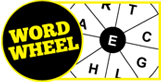
With the word wheel, the idea is similar, but with two differences:
Firstly, you have to find as many words as you can, within the restrictions of the puzzle, as outlined below.
Secondly, every word that you find must use the central letter. It is worth noting that there is usually at least one word that uses every letter given. Therefore many solvers like to focus purely on finding the word that uses all the letters, rather than looking for all the smaller words too, which of course can take quite a lot longer, particularly if the puzzle has many common letters and therefore there are a large number of words that can be made from the wheel.
Now, the rules of the game vary from publication to publication. The most common rule is that words must be of three or more letters to count as valid, although some newspapers specify you must make words of at least four letters.
Plurals are virtually always banned, as are proper nouns. Some publications go further still and ban certain parts of a verb and more besides. Other publications have more open-ended rules and just ask you to find as many words as you can, and don't explicitly ban proper nouns or plurals.
Many puzzles have word targets in place, for instance what counts as a good score, an excellent score, and so on. These are just a guide and are usually set based on a certain percentage of the total number of words to be found in the puzzle. Some solvers like to challenge themselves to beat these targets, whilst others are quite happy just to find as many words as they can.
Our online puzzles are mainly six-letter words, and differ in that we tell you exactly how many words we want you to find. We also list the boxes in increasing letter length and also in alphabetical order, to make it easier for you to keep track of which words you need to find. Often we don't request an exhaustive list of the words that can be made, but tend to stick to more common words to make the puzzles fairer to solve.
And really that is all that there is to the wordwheel puzzle. There are a couple of different ways of tackling these puzzles, and these are outlined in our Wordy Puzzle blog entry entitled tips on solving wordwheel puzzles.
If you have any questions on the rules of wordwheels, then please do paste them below and we'll see if we or other members can help.
Date written: 25 Mar 2015
Comment on this post
You must be logged in to comment - please Register or Login
Learning To Solve Codewords
Learning to solve codewords takes patience: they are one puzzle type that you definitely get better at over time, and can find extremely difficult the first few puzzles you solve. After that you will find tactics that work for you, and will be able to...
Added: 26 Mar 2015
Solving & Lit Clues In Cryptic Crosswords
When you are solving cryptic crosswords, most of the clue types that you come across are fairly intuitive: for instance a double definition clue fairly obviously involves two definitions that lead to the same answer. And an anagram clue, sure enough,...
Added: 11 Apr 2015
What Is A Pangram?
Most commonly people have not heard of the word pangram. If they have, then they often get it confused with tangram. Although they share the first letter, that is all that there is common between them.
A tangram is something lots of kids do at school...
Added: 06 Apr 2015
Solving US Crosswords As A Brit
British solvers who venture across a US crossword, perhaps when on holiday, will notice that it is a very different beast.
The main difference you'll notice is that there are so many more clues and answers in a grid of a given size, and that answers...
Added: 14 Jun 2015
Punctuation In Cryptic Crossword Clues
When you start solving cryptic crosswords, you will notice that some clues contain punctuation.
Whereas in English there are set rules as to where and how to use punctuation, and what the punctuation means, with cryptic crossword clues this is not...
Added: 14 Apr 2015
Back to Puzzle Blog
Puzzle Types: