
All About Word Ladder Puzzles
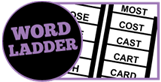
The first version of the puzzle lists clues alongside it, whilst the second version is open-ended with no clues alongside each rung of the ladder, and therefore is both more difficult to solve and may have multiple solutions.
All the puzzles on this site fall into the first category in order to ensure a single solution that can be validated on each occasion.
The rules of word ladders are as follows:
Change one letter on each rung of the ladder from the word above (or below) on the ladder. For instance FOOD to FOND is a valid move. You are not allowed to shuffle the order of any letters, and you also must not make a proper noun - only words in the dictionary with a lowercase first letter are acceptable answers in a word ladder puzzle, unless it is a puzzle with clues, in which case the answer to the clue may be a proper noun.
The word ladder puzzle as a type was invented by Lewis Carroll, famous for Alice in Wonderland, and according to wikipedia it happened on Christmas Day in 1887 - it's pretty rare that you can trace the existence of a puzzle type to a specific person, never mind a specific date!
Most word ladders in publication appear with four-letter words, although it is possible to make them with words of several different lengths. Occasionally you will see children's ladders using three-letter words, and also fairly common in publication are five-letter word ladders. Six-letter word ladders are almost never seen and are said to be less interesting to solve. Four-letter word ladders usually have four blank rungs for you to fill-in, so there is usually one step where you move to a letter that isn't in the solution word (at least at the same position), in order to then be able to make another word that does move you closer to the solution.
Sometimes the start word and end word will be related in some way (such as being opposites), whilst on other occasions two words are picked at random for these puzzles.
When it comes to solving word ladders with clues, then the process is straightforward: use the clue and the fact that you are just changing one letter at each stage to help you solve the puzzle.
When solving puzzles without clues, the process can be a lot harder. General approaches involve:
- Starting at the top of the grid and seeing how far down the ladder you can go without getting stuck;
- Starting at the bottom of the grid and working your way up and seeing if you can meet in the middle;
- Simply finding as many words as you can that are valid on one rung of the ladder relative to the word placed before/after it, and then systematically trying each in turn to see if you can complete the whole ladder.
A word ladder with a single solution from an agreed list of words is called a closed puzzle, whilst a word ladder with multiple solutions from an agreed list of words is called an open puzzle. Most valid (solvable) four-letter word ladders with four empty rungs are in the open category and have multiple solutions.
Do you like word ladder puzzles? Do you find them tricky to solve or have you found a solving method that works well for you? Please do share your thoughts below.
Date written: 16 Mar 2015
Comment on this post
You must be logged in to comment - please Register or Login
Cryptic Clues That Refer To Other Clues
Clues that refer to other clues in the grid are quite common when solving cryptic crosswords, and also occasionally appear in quick crosswords, although less often.
In the latter case the referencing is usually quite straightforward, such as simply an...
Added: 20 Apr 2015
Cryptic Crossword Anagram Indicators
When solving a cryptic crossword one thing you can be sure of is that there will be some anagram clues, or partial anagram clues, in the solving mix.
Some cryptic crosswords have over 50% of the clues containing anagrams in some form, whilst even the...
Added: 16 Apr 2015
What Makes A Valid Crossword Grid?
What constitutes a valid crossword grid varies from country to country. Here we focus on what counts as a valid grid in the UK.
- Firstly, the grid dimensions should be odd, eg 13 x 13 or 15 x 15; these are the two most common grid sizes. In the vast...
Added: 07 Apr 2015
How To Solve Anagram Clues
Solving anagram clues is different for quick and cryptic crosswords. With quick crosswords, the anagram is always indicated, either by (anag) or (anagram) written after the clue.
In contrast, with cryptic crosswords, it is never quite clear what the...
Added: 21 Mar 2015
Codeword Solving Tool
If you want help with solving codewords, then there are various tips and techniques that you can use, as outlined on other blog entries here at Wordy Puzzle.
However, sometimes if you get completely stuck on a puzzle, then you might want some outside...
Added: 18 Mar 2015
Back to Puzzle Blog
Puzzle Types: